Wednesday, December 30, 2015

proa gunwales

Down the road I saw a glassfibre sailing canoe parked on a lawn and inspired, have recommenced proa-gluing. Last year's problem that prevented Any Work Whatever was that a torsion box, deprived of one side, isn't a torsion box at all, and a hull therefore needs stiffening along the top of where the missing side isn't. (Actual reason: laziness.) Proper boatbuilders don't seem to worry much more about this floppy top-edge than calling it a gunwale so's to sound nautical and making it thicker; blessed without experience I have worried about the flimsiness of radiata pine which is the thickening wood available in the timberyard. My neighbour, who has sailed practically forever, opines that I should stop worrying about special woods and use what's to hand. It eventually occurred to me that strip-planked canoes are made of flimsy cedar and the covering of glass gives them adequate strength; reluctantly since it meant making a decision I Got On With It.

First I drew a line where the two ends join in the middle so the top-of-the-profile is straight instead of a shallow vee, which up till now it has been, the result of worrying about the bottom of the boat and not the top.

Then I glued bits inside the decked bulkheads. This took an afternoon.

Bits. Glued. Plus workshop boots reinforced with pair of old trousers stuck to outside to a) hold the foam on t'outside of them and b) further embarrass the children.

Then I glued bits inside the sort-of-tub thingy. This took another afternoon.

More bits. Glued.


Adding bits is a ghastly business fraught with worry. You have to mix epoxy and get a tight joint, and the epoxy acts as a lubricant so the glued bits slide about on one another and I haven't enough clamps. So everything gets screwed together and later I shall have to plug all the screw-holes with epoxy and paint so nobody apart from the Internet knows. Add usual carelessness and the reinforcements weren't where they should have been and this meant having to pretend I meant to use a router afterwards to align the central gussets.

Routing.

And glue strips along the top of the gunwales to fill the gap that wouldn't have been there if I'd cut the sides along the top in the first place. Each operation whereof taking another morning and another afternoon. Still, the art of woodwork is that of concealing your mistakes. Besides, my neighbour reassuringly tells me boatbuilding isn't precision engineering and that the Pacific islanders manage it with a tree and an adze.

Centre gussets
Precision woodworking with drawknife and spokeshave


Skateboard with angled bits of wood attached for rolling increasingly heavy hull round workshop floor

Popsicle sticks glued into gaps so that nobody will know what a rubbish woodworker I am

Wisdom prevailed in the decision whether to attempt the last part in one go: best to glue all the separators to the outer-bit first. And this turned out to be a sound decision because
1. I didn't mix enough glue and
2. I didn't think out how I was going to attach the separators accurately and
3. glue/lubricant/slides all over the place (see above) and
4. not enough clamps (you already saw above) and
5. only two arms grow out of a person and you need four.

Screws were the solution once more. I got John to operate the screwdriver and it still took a solid morning.

Only two lots of glue-mixing this time - 30cc + 10cc first, and when that ran out 45cc + 15cc, and just as I was finishing using the second lot it went all exothermic and hardened rather abruptly, putting paid to my planned use of any excess to plug all the preceding screw-holes in the hull.


Glued and screwed. Screws to come out when glue is hardened.


Amazing how much you can't accomplish between 8.30 and 1.30.

Anyway all is now glued and stiffened but unfortunately that means I need to do the next bit, which requires another Making of a Decision, at which I'm not as good as I am at Procrastinating.


Labels: , ,

Monday, October 14, 2013

Bulkhead

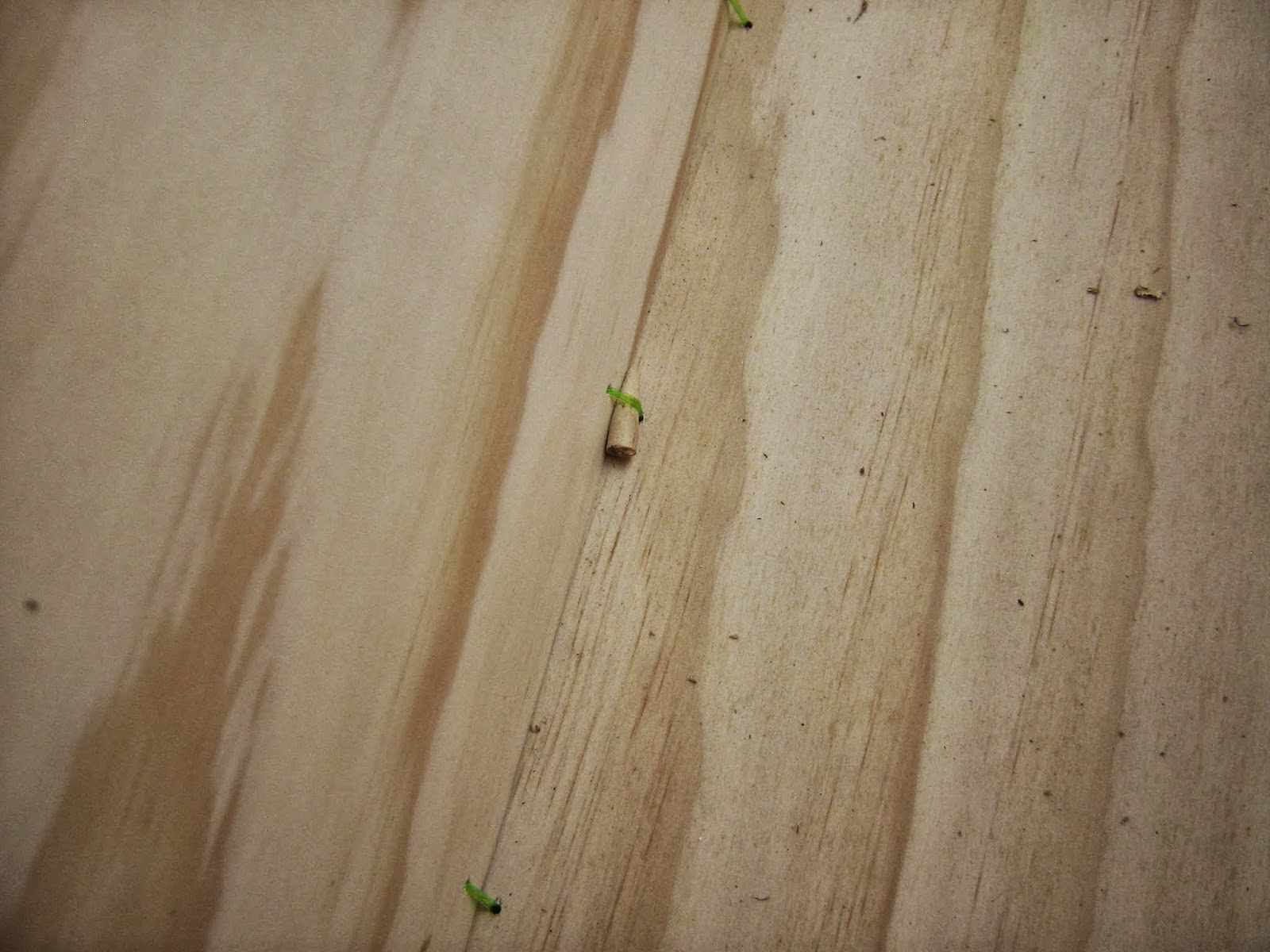
Well it turned out that hammering wedges into the stitches to move the side planks outwards was a useless idea. Didn't work at all. What did work, and worked easily, was using the planks as a lever, opening them a little, and inserting pointed dowels into the inside stitches. And I didn't need very many either. It was most pleasing. The dowels were made pointy with my newly patented proa-stitch-tightener-conical-wedge-making-machine and if you would like to send me a hundred thousand dollars I will tell you where you can get one. (Clue: pencil sharpener.)


The one end that's now sewn together is a big floppy item, remarkably unlike anything you'd put to sea in. It has to be stiffened into a torsion box with a decked-in end and a wossname - a thingy - all the nautical terms escape me - a bulkhead, thank you. I need to seal each end into a huge hollow box using a deck and a bulkhead, not only to stiffen the structure but also both to contain air as flotation and to remove swampable volume. How much sea will come in is not yet known, but when Graeme came poddling over from next door to see how I was getting on and I started to ruminate on where to step the mast, he recalled that he hoped I was going to start with the Optimist rig.
'There's a lot of wind out there. You won't want much sail. Not while you're learning.'
I intend to try a shunting rig eventually but I tend to pay attention to Graeme. He's lived in his house since 1948 and sailed at the wharf at the end of the road for most of those years. When the sun comes out after a cool night, the onshore winds are - um - exciting. Even in the Optimist they're exciting. You come back to shore and a little old lady walking her dog along the seafront stops and says
'I bet that was a good sail!'
and you hazard a private guess that she was once Graeme's Outdoor Ed mistress.

I hied me along to the builders' merchant with an offcut from the side planks and examined their racks full of plywood until Jasper came out to attend to me.
"Hi Jasper, I'm after some sheets like this."
"Uh, let's have a look - that's 4mm SS UT and it should be in this rack, aaaaand - looks like we haven't got any. It's Woody, not Jasper. I do look like Jasper. Only more handsome."
"Oh, sorry, Woody."
"Woolly. Not Woody."
"Oh, sorry Woolly. - Why d'they call you Woolly?"
"Short for William."
Damn. Willie. I can never quite get the local accent. - One of my neighbours always calls me Ruptured. -

Anyway, as Jasp -  as Wullie pointed out, there was no 4mm SS UT. And none in Nelson, Takaka, or Blenheim, according to their computer. No demand. At $76 dollars a sheet I can imagine the explanation, but it means that I'm either going to have to use 4mm CD UT or order a palletful, which means sixty sheets. SS means both sides have a lovely smooth intact veneer. CD means only one side is smooth and the other side is oh, so-so. UT means untreated, were anyone to ask. I gather it takes glue better. Though how they glue it up into ply becomes an unanswered question.

Accordingly I have the choice of whether to put the so-so side on the outside where at least I can keep an eye on it for delamination, or use 7mm ply instead.  Since every naval architect  tells me that boats always get heavier as you build them, I'm taking a chance on the rubbish grade 4mm, and reinforcing all the edges.


The next task is to glue laths around the bulkheads' edges, and this includes gluing a reinforced hole in the middle. Slightly dodgy 4mm ply isn't going to like inspection hatches, but I don't want a sealed bulkhead full of damp and foetid air where rust and moths break in and steal. - Specifically, rot since the wood is untreated. - So it needs a whacking great big opening that can be removed after each excursion. Mr. Grill had the cunning idea of fitting the top of a bucket as a waterproof hatch.


CRT's buckets are $28 each with a lid but we have lots of old paint buckets wh. are free, and I like the idea of free. Unf. those paint buckets go brittle in the sunshine, so I'll have a problem when the inevitable happens. A bridge to be crossed anon.


In order to make the hole a nice circle I made a compasses extension for the jigsaw, and drilled a central hole as a pivot, and proudly started cutting, and it didn't work. The jigsaw cut a spiral, not a circle. When I watched, the reciprocating saw-blade began to flex at an angle, the angle increasing as the curve proceeded. I took the extension off and cut it much more accurately by hand.


It keeps surprising me that sticking a motor onto a tool is a way of simultaneously making it more saleable and less controllable. I can't think why I should be surprised, since it's a fairly consistent result. We are sold the idea that attaching 400W and a long black cable with an electric plug at the end of it will now obviate the need for skill.

Labels: , , , ,

Thursday, October 10, 2013

More sewing

In a publication called A Spirit of Enquiry Essays for Ted Wright 1993 there's an essay entitled Sewn Boats of the Indian Ocean; and Plate 20.3 shows a Saamish sewn boat in the village of Notozersk, Russia. As the Indian Ocean is no-where near Russia, we conclude that sewing and navigation are divorced skills.

Certainly sewing and arithmetic are divorced skills: I was so keen to get on with sewing the garboard strakes together that I didn't pay attention to how long the boat was going to be until I noticed that I was going to have to chop seven inches off the blunt end or the side planks wouldn't meet in the middle. Think you're stupid?  - Not as stupid as me.

I put the templates on the upturned Optimist and found that I was short of quite a lot of area. My boat was going to sit quite a bit deeper in the water than I hoped.

Mr. Dierking's solution is to bolt a box in between the ends, extending overall length by quite a bit. Having plenty of offcuts, I thought I'd glue some 7mm thick side-plank extensions on to restore my missing 14 inches.


Out with the router: machine a 2mm deep strip at one end of the extension, offer it up against 4mm side plank, wonder why 2mm is standing proud, realise 7mm minus 2mm does not equal 4mm, wonder where brain was this morning, say usual word, put head momentarily in bucket of water, machine 2 more mm off, now have flat surface when the two are touching.

I mixed up some epoxy and having now read the Epiglass instruction PDF, simply put bricks on top of them because I'd just read that the epoxy sticks better if it's a millimetre thick rather than a squozen-thin layer of glue.

 
They were left for 36 hours partly because it's cold and partly because I had a bicycle fork to replace. And with the broken fork in mind I didn't want any stress concentrations so afterwards I set to work feathering off the over-glued parts, and it's a good job I did because quite a bit of it had no glue underneath. It merely looked glued. This joint is going to be in the middle of the boat, the point of maximum strain. I do not want it to break. I put a flap-wheel in the drill and ground away everything that wasn't glued, firmly resolving to be careful when applying fibreglass tape afterwards.


Next to sewing, and back to the original plan of standing the thing upright, dodging round it like a damsel round a maypole as I tried to poke the monofilament three times through a 2mm hole. That wore a bit thin and I got John to help, and when he wore a bit thin I finally tried a needle and wished I'd done so before because then it was quite easy. The nylon won't go through the eye of the needle any more than a camel will go through a rich man, but I found that tapping the nylon with a hammer flattened the end and then it did go through, and the nylon jammed in the hole and didn't work free so I was much pleased with myself. Four metres of nylon does mean you have to take your shoes off or you're always tangling things up.

I found the only way to keep the stitches tight was to sew it with the side planks open, like a tryptich.


Eventually I had to tackle the curve.

 
And to make the curve easier, I used the copper wire as a temporary fastening, heating it red hot to anneal it because otherwise it's too stiff and breaks on being twisted. The final stitches were 'stremely difficult, and I might have to think a bit more about this for the other end.


Pleasingly, the two curves matched, though there is a transition point. The side plank sits on the outside of the pointy end of the garboard strakes, and actually makes a neat join.


Moreover the sides struggle with my imperfect woodworking fit, and needed some gentle coaxing with a broken kitchen knife to transish at matching points on each side.


But where the sides sit on the top of the middle bit of the boat's garboard strakes, they slide down inside the boat, leaving a sticky-outy-ledge on the outside. I shall carve lots of tiny wedges and hammer them into the lashings inside the boat, and hope and pray that they squeeze the side-planks outwards to make a smooth outside edge.


Finally I sewed the ends of the sideplanks together, and coming to the bottom found a vast cavernous gaping hole which will have to be plugged with teased-out chopped strand mat glass fibre.


It can be the back end of the boat.


I expect it'll be all ugly and lumpy and make all the boat-builders wince inwardly but who cares? The front end can be pristine and glorious and beautiful and sharp and slice through errant jet-skiers like a scalpel, making all the swimmers happy. Swimmers hate the jet-skiers. They always ignore the 200 metre buoys and come ploughing inshore at full speed. Actually everyone hates the jet-skiers, even the jet-skiers themselves. I've often watched them. A huge effort to launch the craft, ten minutes driving pointlessly round in circles too far off-shore to entice the applause of an admiring throng. Then they come back to the beach a bit shame-faced, squirting out two-stroke fumes before switching off the engine and trying to round up parents and grandparents to pull the ghastly vehicle out of the water onto a boat trailer. Bit of luck the eventual oil crisis will deal their death blow.

Labels: , , ,